
Posted on — 2 Comments

2 Hot Lefse-Baking Tips

You may have to modify your old lefse grill to be able to use newer probe control models.

The title is not hyperbole. I am giving you two hot lefse-baking tips — hot, as in temperatures of up to 500 degrees F — that allow you to get full power to your most valuable lefse-making tool, your grill, and to prolong its life.

I have several lefse grills that I use for my lefse classes, but during my last batch of classes I discovered I had two grills that no longer worked because the electric probe controls were shot. They had burned out. If you’ve had your lefse grill for a while, you may have had this problem. So …

Alternate use of the electrical probe control every 1 1/2 hours of grilling lefse.

Hot Tip #1: Purchase a second probe control.

In the “How to Use Your New Grill” section of the Bethany Heritage Grill instructions, it reads: “It is not recommended that the probe control be used continuously for periods of more than 1 ½ hours at maximum temperature. At that time, allow the probe to cool down for 30 minutes before re-using. Alternate probes may be used to continue baking.”

I had never alternated probes in all my years of making lefse, which probably explains why my probe had burned out. I now have an alternate probe.

Here is how Roxie Svoboda, president of Bethany Housewares, summed it up when I interviewed her for my latest book, Keep On Rolling! Life on the Lefse Trail and Learning to Get a Round: “If you alternate the controls, you’ll have better luck making your grill last longer. Have two controls; we sell just the control separately. Put a different control in every hour, and let the other one cool off. We have people get together as a family and bake for eight hours. The grill is OK; it can handle it. It’s the control that you should change every hour or so.”

Hot Tip #2: Modify your old grill for a new control probe.

I bought new probe controls for my old grills, but the new probe controls didn’t fit snugly into the receptacles of the old grills. The probes didn’t go into the receptacles far enough for the grills to heat up sufficiently to bake lefse. Hmmm. So I emailed Roxie, asking if Bethany carried controls that would fit old models.

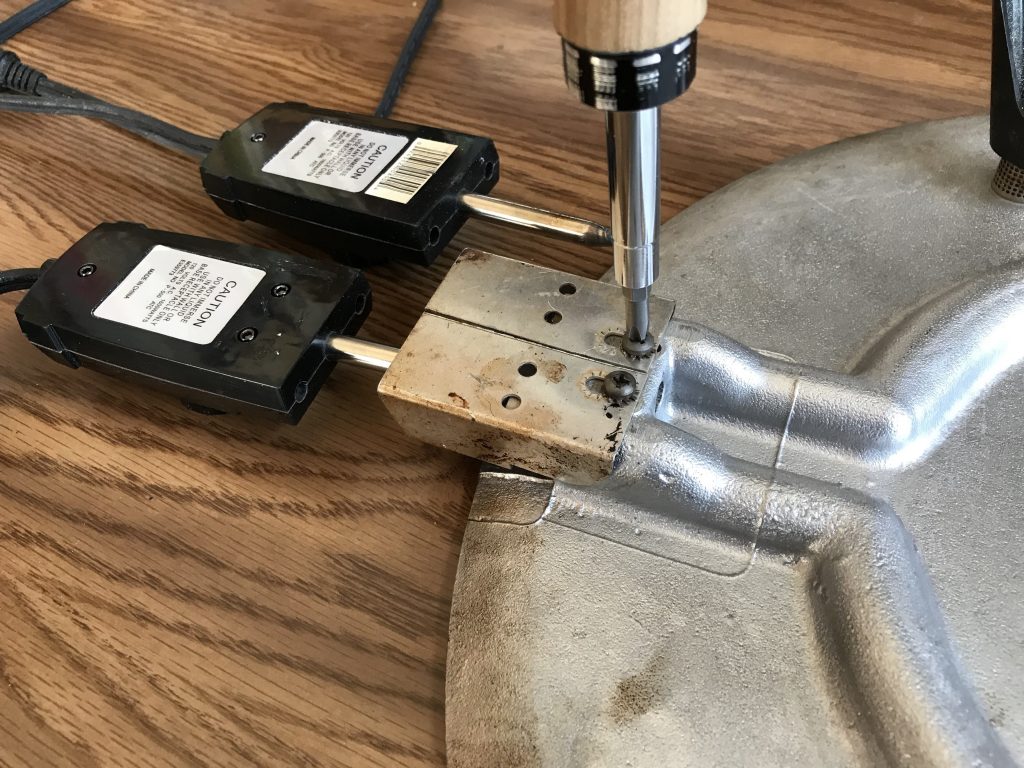
She responded that Bethany did not have old controls, but new controls work in older grills “with a slight modification.” Here’s how to modify your old grill for a new probe (see photo opening this blog):

  1. Turn over your old grill. You’ll see two screws that secure the aluminum shield wrapping around the receptacle into which the probe control fits.
  2. Loosen those screws and slide the shield toward the center of the grill.
  3. With the shield in its more central position, re-tighten the screws.

This allows the new probe control to fit deeper into the receptacle and supply full power for a 500-degree grill.

“If this does not solve the problem,” added Roxie, “you may have a grill that has larger prongs [probes] that were produced for a short period about 30 years ago, before we purchased the company.”

In this case, the solution is to replace the larger probes. You need to send the grill and the probe control to Bethany, who will replace the larger probe with a smaller one. The charge is $20 plus shipping. Roxie advised to include a note in the shipping box that has your name, address, phone number, and a brief description of what you would like done.


Posted on — Leave a comment

‘Sewer Trout’ and Lefse

A 1956 photo of Verna Spencer with her son, Nolan Spencer, who was in Bagley High School at the time.

I’ve been reading The Last Word On Lutefisk, which brought back memories.

In 1947 my parents, Ed and Verna Spencer, built a small store open seven days a week. They called it the Hi-Way Store, which was located 1 mile west of Bagley, Minnesota, on U.S. Highway 2. This was just after Dad returned from serving in the U.S. Army in the Philippines. He used his GI bill to build the store.

Dad traded guns, rented outboard motors, and sold fishing tackle and minnows (that’s a minnow tank in the picture). He and Mom also ran the grocery. What saved the store was they were able to obtain a 3.2 beer license — the only one in Clearwater County — that allowed beer sales after noon on Sundays.

Mom and Dad sold sill all year and had lutefisk delivered around Thanksgiving and Christmas. Like the sill, the lutefisk came from the Hogstad Fish Co. in Duluth. The fish arrived in short, wooden tubs about the size of a small washtub. My after-school job, at age 9, was to change the water for the skin-on fish.

‘Sewer Trout’

Francis “Fritz” LaRoque, half French and half Ojibwa, and his full-Norske wife Harriet would come in to buy what he called “sewer trout.” I’ve never heard that title used anywhere else.

Dad established a trailer court, as he knew a pipeline was being built from Saskatchewan to Duluth beginning in 1954. The pipeline workers filled the court with 54 trailers. At the end of the pipe-laying season in November, maintenance personnel stayed to “lay up” the equipment (change oil, drain radiators, etc.) before the “drag-up dust” (snow) arrived.

One woman came into our store and saw the tubs of lutefisk. She asked what it was. Mom explained it was a seasonal, cured codfish that Norwegians and Swedes enjoyed during the holidays. “Oh, we like fish,” said the woman, who sounded as if she hailed from in a southern state. “I’d like two pounds.”

When the woman came back the next day, Mom asked how she liked the lutefisk. “Oh, it was great, but it kinda stuck to the fryin’ pan.”

Can you imagine the smell of fried lutefisk in an 8 x 32-foot trailer house?

My First Lefse

My first taste of lefse came in 1948 when Violet and Einar Jallen, Dad’s sister and brother-in-law, lived with us for a winter. Einar had to have lefse! The lefse was baked on the covers of the wood- or coal-burning side of the combination range my folk owned. The wood/coal burner flanked four gas burners.

My job was to split up wooden apple/orange/pear/peach crates to provide fuel for lefse baking. Violet rolled the lefse, and Mom baked it using the sharpened window shade bottom “slat” for a lefse stick. I was hooked on lefse from that point on.

That’s Mom and me in the above picture during the summer of l956. I had one more year at Bagley High School, and then I attended Bemidji State Teachers College. I obtained degrees in biology and chemistry education. I taught one year in Beloit, Wisconsin, and then 35 years in Crosby-Ironton, Minnesota, before I retired in 1997.

I married Sharon Gilbertson, who I miss as she has passed on. We were too poor to buy a lefse grill, so I had a friend cut an 18-inch disc out of ½-inch steel for baking lefse. It went over one of the burners on our gas range and worked just fine.

Combining a bit of lefse and lutefisk, I leave you with this cheer that was a rouser when our high school teams opposed the Greyhounds from Fosston, a town 17 miles west of Bagley. It goes:

Lutefisk and lefse
Gammelost and sill
We can beat those Greyhounds
You doggone right we will!

Posted on — Leave a comment

Listen to the Best Lefse Song Ever

Marge Kellor took this photo of me performing “Keep On Rollin'” before members of the Scandia Lodge of the Sons of Norway in Waconia, Minnesota.


I’m on a lefse tour these days, barnstorming with my books and making speeches about lefse and lutefisk to any group that might find entertainment and humor in hearing about these traditional foods. The speech highlights a fun afternoon or evening, and I always look forward to ending my presentation by singing a lefse song I co-wrote with Erik Sherburne from St. Paul. The song is “Keep On Rollin’”, which is a benediction for my latest book Keep On Rolling! Life on the Lefse Trail and Learning to Get a Round and, I can confidently say, is the best lefse song ever recorded on a Tuesday evening in December.

Erik wrote the music, and I wrote the lyrics to this lefse song for voice and piano. It’s a tune that honors the tradition and fun of lefse making as well as the resiliency, faith, and gratitude of lefse makers who just keep on rolling throughout their life. This “family” song is easy to sing and easy to play whenever folks gather to make and eat lefse.

“Keep On Rollin’” is eight pages filled with three verses, a bridge, and a rousing chorus. Many people have purchased the score after they hear me sing the song. Typically, the audience starts singing along in the chorus after the third verse, and the song invariably brings down the house.

People who cannot attend my presentation have asked if there is any way to hear a recording of the song before buying the sheet music. I’m happy to say that yes, now they can. Listen to my recording of “Keep On Rollin’”, with Dorothy Williams at the piano.

Posted on — Leave a comment

Make Friends With Lefse Sticks

With lefse sticks, here’s what you do

Beyond just flipping rounds.

You make them for a chum or two

Now friendship knows no bounds!

Nolan Spencer’s gift to anyone he teaches to make lefse: a homemade lefse stick.


Wanna make friends fast? Make lefse sticks and give them away.

“Oh, I can’t make lefse sticks,” you protest. “I’m not good working with wood.”

Oh, yes you can! Here’s a simple way to make a sturdy and stylish-looking lefse stick — and you can get the wood free.

This tip came from Nolan Spencer, who I featured in Keep On Rolling! Life on the Lefse Trail and Learning to Get a Round. He recently made the lefse stick pictured above and mailed it to me from his home in Deerwood, Minnesota.

“I’m cheap,” wrote Nolan, “and I make them from 5-gallon paint stir sticks, which I get free of charge at The Home Depot. I jigsaw the ends, plane down the sticks, and finish them on my belt sander. Everyone I teach lefse making to gets one. You’re an exception, Gary. Give it a try, and keep on rolling!”

Will do, Nolan, my lefse friend!

Nolan Spencer with a photo of himself and his late wife, Sharon.
Posted on — Leave a comment

The Joy of Ricers

My love is like a red, red ricer …

Gary’s note:

Roses are red

Ricers are, too!

Give one to your luv

And make lefse for two!

Becky Latka is back, blogging away about her colorful collection of 50 vintage ricers. This is a very RICE story that begins when Becky was in grade school.


I love vintage kitchen utensils in a variety of colors, and I love lefse. So my obsession with colorful vintage potato ricers is a no-brainer.

My first two ricers were red, both from my Grandma Skarstad and used for making lefse with the whole family when I was in grade school. I thought all potato ricers were red until I was in my 20s and saw a green one in an antique store. But my obsession didn’t begin then, and I didn’t buy that green ricer.

It was years later when I started making lefse with my children that I realized I needed more than my two red ricers. Ricing always seemed to be a bottleneck in the process of making lefse, the result of owning a limited number or ricers. I started asking friends to join me at my lefse-making events, and I increased the amount of potatoes we’d process into lefse. My friends were willing to help, and it was clear we needed more ricers!

I bought a couple brand new ricers. They were not colorful, and I wasn’t happy with the newer models. One had aluminum handles that bent after a few attempts at ricing potatoes. The other had holes in the basket that were too small, which caused too much of the potato to be trapped and wasted. Grandma’s ricers worked best. If only I could find more like hers!

A rainbow of ricers.

Buying Binge

I started buying “old school” colorful ricers whenever I’d find them in antique stores (not often in Nebraska, a state practically devoid of Norwegians). Red ricers were still the most common followed by green. Then I found black and blue and beige, and over the years I’ve added orange, yellow, teal, and white! Most of the vintage ricers are similar in style to my Grandma’s, but there are two other vintage styles that I find less often. One is cast iron with narrower handles (for small hands), and the other has a thin area on the top handle over the basket.

As family and friends learned about my ricer collection, I started receiving ricers as gifts. I was accumulating so many ricers that I had to establish criteria for purchasing additional ricers. They needed to be a color I didn’t have, or they had to be marked at a price too good to pass up.

I have ricers hanging on my kitchen wall, on my basement shelves, and in a vintage aluminum bowl as a centerpiece. I have red ricers that are only used for lefse-making, ricers that I will part with as gifts, and ricers that I sell at The Lefse Shoppe. I have 50 ricers, including one recently sold and another recently purchased.

Life’s nicer with ricers — lots of them!

I love vintage items, but especially items that are still useful. To some, my ricers may be clutter, but not to me — not as long as they spark joy and loving memories. And not as long as they have a superior design and are more efficient than any modern ricer. What’s not to love?

Posted on — 1 Comment

Video: Krina Lefse Topping

Gary’s note: This is the final installment in Les Olsen’s three-part blog about krina lefse, a “very yummy” lefse, as Les puts it. The previous blogs (below) covered the tools for making the base krina-lefse round as well as the lore about krina lefse in Les’ family. This blog includes the topping recipe and a video on the fun application of the topping to the base round.


This is my family’s recipe for krina lefse topping:

2 eggs

1/2 cup cornstarch

1/4 cup sugar

3/4 cup milk

2 cups flour

Beat eggs until mixed. Add milk. Fold in cornstarch and sugar. Fold in 1-1/2 cups of flour. Then add just enough flour until when you pull a spoonful of topping out of the bowl, it will stretch and tear (see video). When the topping is thick and stringy, it will hold the pattern.

Take a round of krina lefse, place it on the countertop and place a large spoonful of topping on the lefse. With the spoon’s edge, spread the topping over the entire lefse round, all the way to the edges. If the edge is not covered, it will brown too fast.

Use the krina tool to scrape the excess topping off the lefse. Spread the topping in one direction, leaving only the ridges of topping.

Now use the krina tool to make the pattern in the topping. You can create your own pattern. We use my grandma’s pattern (see photo and video). I wonder how many pieces of lefse my grandma, mom, and I have finished with this pattern.

Between the krina lefse tool and the lefse turning stick is Les’ krina lefse topping pattern.

Place the lefse with topping on a baking sheet and put under the broiler. Set the broiler on low and the rack 6 inches below the broiling element. Here is the tricky part: Watch the lefse to make certain the topping turns only a light golden brown. This takes about 2 minutes under the broiler. Do not close the oven door. If you broil the topping too fast, it will bubble up off the lefse. Remove the round, and to keep it from curling, stack your rounds under flour sack towels and the heavy ¾-inch plywood (see video).

Final Preparations for Eating

You may wonder when you finally will get to eat krina lefse. Well, your stack of krina lefse will keep for months. After a few days the lefse will dry and harden.

When you are ready to eat krina lefse, run each round of lefse under warm water and place it between flour sack towels. DO NOT STACK. With a spray bottle, mist the lefse and towels every 5 to 10 minutes. The lefse will soften to an edible state in approximately 1 to 1-1/2 hours. At that point, butter the side without the topping, and apply cinnamon and sugar to taste. My cousins in Norway mix the butter, cinnamon, and sugar together and apply. Place the two pieces of prepared lefse together, topping sides out. Cut into wedges and serve.

Here is an alternative to cinnamon and sugar: In 1997 while in Norway, I visited a restaurant in Rognan where the heated krina lefse was served with melted brown cheese, sour cream, and butter. Very yummy!

Posted on — 2 Comments

How to Make Krina Lefse & Flatbrød

Gary’s note: This is the second of three parts of Les Olsen’s fascinating blog about his family’s flatbrød and a very special type of lefse: krina lefse. Learn how to make it just in time for your Super Bowl gathering!

Krina lefse tool.

Krina lefse is named for the tool (see photo) used to put a pattern in the topping of the krina lefse. My father made this tool for his mother in the mid-1930s. Before then, I do not know what she used to make the pattern in the topping. Dad and I made several wooden krina tools almost two decades ago to give to the American nieces and nephews for Christmas. My wife’s 90-year old cousin had a wooden krina tool hanging on her wall in her kitchen. She knew what it was but had never used it. I purchased a manufactured krina tool in Norway in 1998 at the Husfliden (a store in Norway for handcrafts). It was made of brass with very deep ridges that left too much topping on the krina lefse and would not hold the pattern made by the tool in the topping.

Here is the easy recipe for making flatbrød, a thin cracker cooked on both sides, or the base for krina lefse, cooked on only one side with the topping put on the other side after cooling:

1/2 cup refrigerated butter—not softened

1 cup whole wheat flour

2 cups white flour

2 cups boiling water

In addition to the 2 cups white flour listed above, approximately 4 cups of white flour will be kneaded into the base after you add boiling water

Mix whole wheat and white flour in a large bowl. Cube butter and mix again.

Now the only hard part: Pour enough boiling water—about 2 cups—on the flour/butter mixture to moisten the flour and melt the butter. Mix with a spoon to moisten all of the flour/butter mix. Moisten so the base is “sticky” not soggy.

After the flour/butter mixture is moist, the butter is melted, and the base is cool enough to work with your hands, start kneading in approximately 4 cups of white flour, 1 cup at a time until the dough, when poked with your finger, returns to only a small dimple.

Ready to Roll

Roll the dough into a 3-inch-diameter log. Cut the log into 5/8-inch slices. Roll these slices into balls, about 2-inches in diameter, and place in a bowl. Cover with plastic wrap to keep from drying out, and put balls in the refrigerator. This amount of dough will make approximately 30 rounds.

Before rolling flatbrød or the base for krina lefse, hand flatten each ball on a pastry board sprinkled with about 3/4 of a tablespoon of flour on the center 4 inches of the board. Flour both sides of each flattened ball.

You are ready to roll either flatbrød or the base for krina lefse.

Flatbr⌀d

When rolling flatbrød, roll the flattened ball into a 14-inch diameter round, thin enough to nearly see through to the pastry cloth. Lift the rolled dough from the pastry board with a lefse stick, place it on 400+-degree griddle, and brown both sides. Put the baked flatbrød in a 170-degree oven for 2+ hours to make it very crisp. Then spread with butter and enjoy.

A stack of flatbrød in the oven.

You can eat flatbrød with dinner, soup, or as a snack. My grandma made mountains of flatbrød at Christmas. During the Christmas season at our house, our daughter’s first stop is to check the oven where we store the flatbrød. And now her 4-year-old daughter is asking for flatbrød with butter.

Krina Lefse

When rolling krina lefse, roll the flattened ball until until the round is about 11 inches in diameter. My cousin taught me to use a 10-inch (or larger) stock pot lid to cut the lefse perfectly round after rolling and before placing on the griddle.

I should note that when rolling the krina lefse, my grandma and mom never cut the lefse with a stock pot lid. When they fixed krina lefse for serving to family and friends, they hand trimmed the rounds to make them round. The trimmings were what the kids got to fill up on; the good stuff was served to guests. Of course, the kids also were allowed a piece of the good stuff.

Bake the round on the 400+-degree griddle until tiny bubbles form on the lefse. DO NOT FLIP THE ROUND. Remove from the griddle and stack between two ¾ x 12 x 12-inch plywood boards wrapped in white flour-sack towels. This keeps the lefse from drying out too quickly and curling.

A stack of krina lefse ready for topping.

Next blog: Video showing how to make and apply the tasty topping for krina lefse.


Posted on — Leave a comment

My Story of Krina Lefse and Flatbrød

Gary’s note: Everyone has a lefse story, and this is Leslie Olsen’s. This blog is the first of a thorough, three-part look at Leslie’s family, their rolling pins, their flatbrød, and their krina lefse. You are probably familiar with the simple-yet-delicious flatbrød, but you may not know about krina lefse, which is as yummy of a treat as you could desire. The lefse rolling pin Leslie describes here is unique in that it tapers at the ends. It was carried from Norway by his grandmother.

My paternal grandparents came from the Lurøy community, west of Mo I Rana, Norway, to Anacortes, Washington, between 1905 and 1910. They were married in the Anacortes Lutheran Church on December 27, 1910.

My grandmother brought a lefse rolling pin with her, made by her father who had the only treadle lathe in the area. The rolling pin measures 26-1/2 inches tip of handle to tip of handle. The rolling area is 17 inches, and it is 2-3/4 inches in diameter in the middle, tapering to 2-1/2 inches in diameter at the ends. The handles are integral fixed and are as smooth as silk, after many loving hours rolling flatbrød and lefse. It intriguing to me how the longitudinal grooves were cut.

My mother married into the Olsen family on New Year’s Eve of 1940 at the Anacortes Lutheran Church Parsonage. In the early 1950s, my mother (of Scotch-Irish and German descent) diligently measured her mother-in-law’s “dump-and-pour”recipe to create a measured recipe that produced yummy lefse and flatbrød every time. This recipe was passed on to her sons. Grandma had seven children. Of those children and their spouses, only my mother learned the traditional baking of the Norwegian Christmas goodies: krina lefse, potatokake, flatbrød, fattigmann, krumkake, and gomme. It wasn’t until I spoke with members of the Daughters of Norway in Olympia, Washington, in the 1980s that I was told krina lefse is named for the tool that makes the pattern in the topping.

My grandmother’s and parent’s homes were a stone’s throw apart. Grandma always kept the rolling pin in her dresser drawer, wrapped in a pillowcase. At Christmas in 1976, Grandma told Mom to keep the rolling pin at her house. Mom said, “No, Momma. You take it back to your house.” That was the last time the rolling pin was ever seen or used by Mom. Grandma moved into a nursing home at Easter 1977. She was 84 years old the last time she rolled flatbrød and krina lefse with that rolling pin.

The rolling pin we have now (pictured) is a duplicate of Grandma’s rolling pin, also make by her father. I found it in my grandmother’s childhood home (Aas hjem) in Norway while visiting there with my parents in 1998. My cousin, Jergen, who was living in the house, said, “Yes, you take it home. No one here will use it. I buy my lefse.”

So, like Grandma nearly 90 years earlier, I wrapped it, placed it in my suitcase, and brought it to America. Before we left Norway, I made flatbrød for my cousins in the northern part of the country and also south of Oslo. As far I know, they have been making flatbrød at Christmas ever since.

Upon inspection of the rolling pin, I found it be to be inhabited by powderpost beetles. When I got home, the rolling pin spent 24 hours in the oven at 200 degrees, hopefully killing any living critters. Have we eaten some dead beetle bodies? Well, that would be a small price to pay to have such a priceless heirloom.

Next blog: How to make krina lefse and flatbrød.

Posted on — 4 Comments

Lefse-Wrap Recipe for the Big Game

Hamlet and a Pickle, the simple-yet-savory lefse wrap that’ll wow Big Game partygoers.

It’s party time!

As we approach the February 4th Super Bowl with NFC and AFC Championship games this weekend, think about taking to your extravagant football parties one of the 13 lefse wraps in Keep On Rolling! Life on the Lefse Trail and Learning to Get a Round.

Just as I can guarantee a Minnesota Vikings victory, I can also guarantee your lefse wraps will be the talk of the table because:

  • Everyone loves a tasty wrap. It’s fun finger food, and you don’t fill up on a lot of carbs—just the savory combinations inside.
  • A lefse wrap is the tastiest of all wraps. Most other types of wraps have wrappings with no taste—zilch. But velvety, toasty, potato-y lefse adds to the texture and the ensemble of flavors. Plus, lefse is pretty with its brown spots and freckles against a golden background.

So forget all the same-old, same-old dishes you’ll find at typical football feasts. Wow revelers with this simple, can’t miss lefse-wrap:

Hamlet and a Pickle

  • Danish ham-and-cheese lefse wrap
  • 4 tablespoons stone-ground mustard
  • 1 pound thinly sliced Danish ham
  • ¾ pound thinly sliced Havarti cheese
  • 8 crisp kosher dill pickle spears

Spread 4 lefse rounds with stone-ground mustard. Cover lefse with a layer of ham, and then cover with a layer of cheese. Lay two pickle spears across the diameter of each lefse. Roll up lefse and cut into pinwheels.

Enjoy, and enjoy the games. Skol Vikes!

Posted on — Leave a comment

From the Lefse-Fest Front

The latest lefse from Connie Bastyr’s lefse fest.

If you want an executive summary of our annual lefse fest, here it is:

  • One griddle
  • Two rolling boards
  • Seven people (one non-Scandinavian)
  • 19 potatoes
  • 40 lovely lefse
  • Thanks to our Lefse Leader: Gary Legwold!!!

For those who want to savor the full report, read on.

It doesn’t really take seven adults to make a batch of lefse this lovely. One experienced lefse maker could do it. But what’s the fun in that?

On a Saturday evening each December for nearly a decade now, my mother, her three daughters, and the sons-in-law share a dinner. Then we all roll lefse while watching the Christmas classic Elf. The movie is so familiar that we can focus completely on getting perfect rounds of Potato Heaven — and we never forget to turn the lefse at the right moment. Well, except during the scene where Buddy the Elf is testing the Jack-in-the-Box toys. Cracks us up every time.

But like Papa Elf’s story about Buddy, this lefse-fest tale needs to go back a few years to its beginning.

Limited Edition Lefse

With two Norwegian grandmas, kids in my family grew up appreciating lefse as a “Limited Edition” treat. It was in short supply, and its fans were not. We watched it being made, but the skill didn’t transfer to us that easily. As adults, we resorted to — brace yourself — grocery-store lefse for our fix. I know. It wasn’t the same, but we adapted in order to survive.

In 1998, brother-in-law Dennis obtained a “fool-proof” lefse recipe from a coworker and bought equipment and supplies. We dusted off a couple of lefse-turning sticks, which had served as kitchen-wall décor, and everyone brought lefse stuff to our family Christmas vacation, where we could devote time to lefse making.

With great enthusiasm and 10 pounds of potatoes, we made the most durable-looking stack of pancake-thick potato slabs you ever saw. It qualified as “potato jerky,” as author Gary Legwold once labeled his own first lefse.

So it was back to the drawing board … and the grocery store.

Lefse Class

Our family’s lefse luck changed a decade ago when Gary became my office coworker. His reputation as a lefse legend preceded him, and when I learned about his sideline of teaching the art of mixing dough and rolling dinner-plate-size lefse rounds, I recruited him to coach our family.

Six of us, including Dennis, attended Gary’s evening class. Dennis had recovered from the Potato Fail of ’98 and was ready to tackle the taters again. That year for Christmas, Dennis asked Santa for a real lefse griddle and a ribbed rolling pin.

We learned to make real lefse, and ever since that class Dennis has spearheaded our annual lefse fest. I have to say that each year our lefse is more round and delicate and melt-in-your-mouth perfect than the year before. Our grandmas would be so proud, and I think Gary might even feel a bit like a pleased Papa Elf himself.

Connie Bastyr is a former editor of Handy Magazine and a lefse aficionado from Minnetonka, Minnesota.